Research journeys of academic and community researchers
Are academic and community researchers fellow travellers or just moving in the same direction? In this blog, the team behind the NIHR ARC West project to create a co-production community of practice reflect on what the project has taught them.
As part of our co-production community of practice project, we invited academic and community-based researchers to reflect on their research journeys – the ups, downs and lessons learned when working together on co-produced health research.
We discovered that while both groups faced many challenges, there were also strikingly similar experiences and frustrations, some of which could be addressed with simple solutions.
Using journey mapping
To capture these experiences, we used journey mapping – a method adapted from user experience design. Journey mapping has been used in healthcare research to understand patient experiences. However, we used it to better understand the experiences of researchers, both those approaching research from an academic perspective and those who draw on lived-experience to work as community-based researchers.
Journey mapping asks contributors to chart their experiences of being involved in a process onto a timeline. It’s a simple method using flipchart paper and Post-It notes.
The resulting timelines identify areas of challenge or ‘pain points’, along with parts of the process which work well or are particularly beneficial. Reflecting on, and comparing, journey maps from different stakeholder groups allows researchers to identify new solutions to common challenges.
How did we do it?
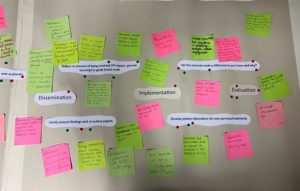 We used Louise Ting’s research cycle diagram as a starting point for creating our journey mapping timelines. For each stakeholder group, we created an unfolded version of the research cycle mapped out over several sheets of flipchart paper. This gave us the structure of the research process for our contributors to map their experiences onto.
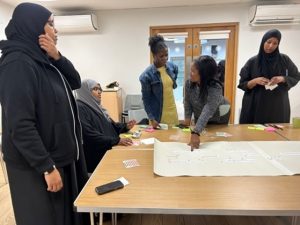
Over 2 months, we ran a series of drop-in sessions aimed at either academic researchers or community-based researchers. Importantly, we worked with these 2 groups separately because we wanted everybody to feel free to share their experiences, both positive and negative, without fear or upsetting or offending others. We made the drop-in sessions as accessible as possible by using spaces and times which we knew worked best for our different stakeholder groups.
Participants charted their experiences of the research process onto a timeline, using:
- Green Post-Its for positive experiences
- Red Post-Its for challenges
- Green and red dots to highlight particularly smooth or difficult stages
What we found
 Across both groups, 3 key themes stood out: communication, training and power sharing.
1. Communication
Good communication was seen as essential by everyone.
- Community researchers valued accessible channels like WhatsApp and informal opportunities to connect, but often felt projects weren’t clearly explained at the start.
- Academic researchers highlighted the importance of maintaining regular contact, even during quieter phases (for example, while waiting for ethics approval).
Both groups noted that poor communication led to problems, but solutions were often simple: using translators throughout, being upfront about the risk of unsuccessful grant applications, and clearly outlining roles and expectations from the outset.
2. Training
Both groups stressed the importance of quality training for effective co-production.
- Community researchers wanted training that supported both research and broader professional skills (such as public speaking, IT skills). Formal training they could evidence for future employment was particularly valued. They also shared examples of how using translators, providing childcare and breaking training down into smaller chunks had helped them on their research journeys.
- Academic researchers felt that a lack of training sometimes left community colleagues underprepared for ethical or procedural aspects of research. They suggested more tailored training around common challenges in co-production.
3. Power sharing
Power imbalances were a recurring theme.
- Community researchers often felt excluded from early decisions, such as choosing research topics or shaping questions, which made later involvement feel tokenistic.
- Academic researchers acknowledged structural limits (funding requirements, university policies, publishing expectations) and expressed unease about relinquishing control over aspects they felt required specialist expertise.
One practical suggestion was to agree in advance who would lead on different parts of a project, ensuring contributions were based on strengths and skills rather than status.
Reflections
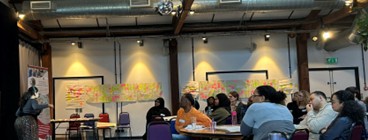
The journey mapping process was valuable not only for its outputs but also for the conversations it nurtured. Seeing experiences mapped out – and recognising overlaps between groups – was validating for many contributors.
The resulting maps have since become useful artefacts for workshops, helping to spark new discussions and remind us what matters most in co-production: valuing, listening to and learning from each other’s experiences.
Our findings show that while academic and community researchers may sometimes feel like they are on different paths, they share far more in common than expected. By addressing challenges in communication, training and power sharing, co-production can move beyond frustration and towards genuine collaboration.